
Athlete behaviour is not driven by motivation alone. It emerges from a complex system of interacting constraints such as physiology, psychology, environment, and task demands.
In this post, I reframe behaviour change as systems design rather than persuasion. Drawing on complexity science and ecological dynamics, I explore how habits stabilise, why change is often nonlinear, and how practitioners can reshape environments to alter behaviour.
By manipulating constraints, feedback loops, and attractors, performance teams can move beyond instruction and design conditions where desired behaviours emerge naturally. Applied Behavioural Sports Science positions behaviour not as a discipline problem, but as an emergent property of the system athletes operate within.
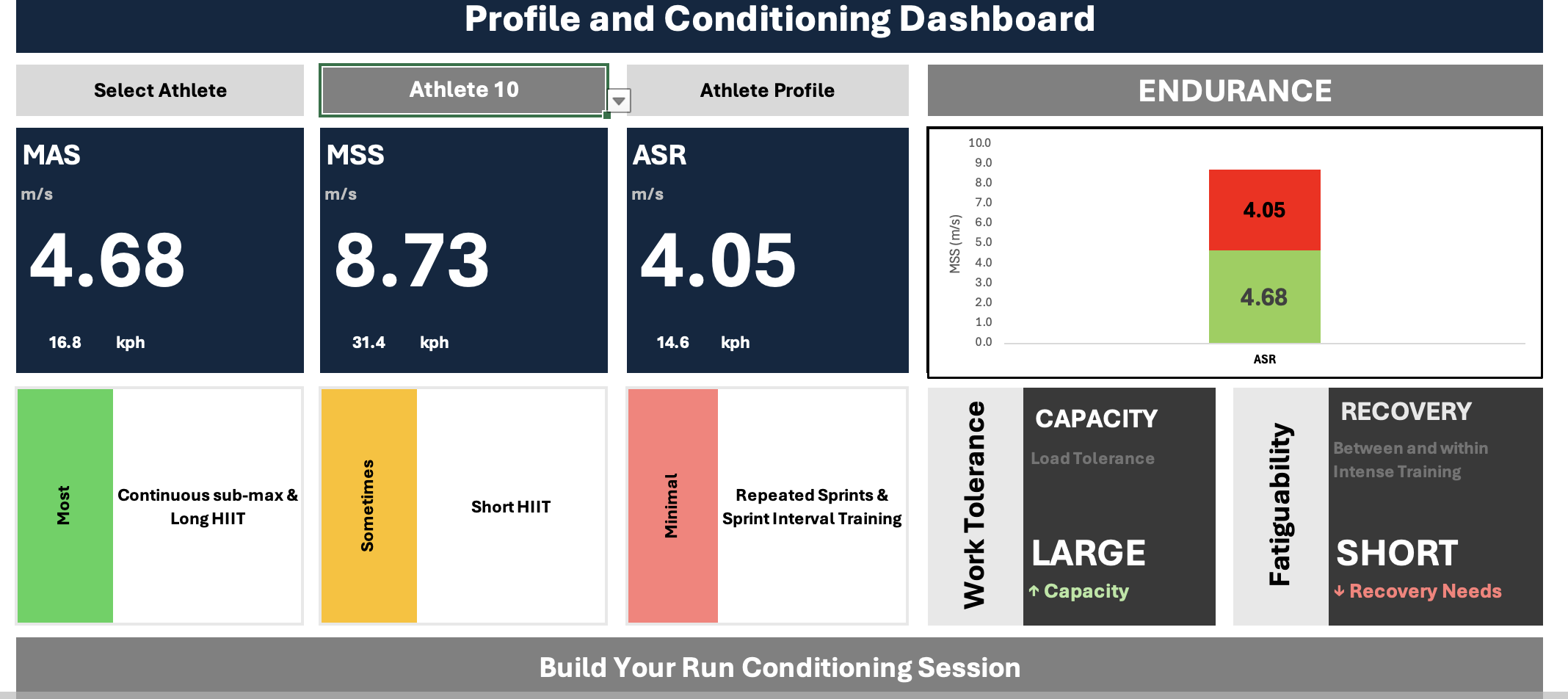
The ASR Dashboard allows practitioners to plan straight line and change of direction (COD) conditioning sessions by inputting an athlete’s maximal aerobic speed (MAS) and maximal sprint speed (MSS). This tool automatically profiles each athlete into their assumed muscle fibre typology and provides training and recovery recommendations, including optimal and sub optimal conditioning intensities and durations. The ASR Dashboard includes both a conditioning tool for an individual athlete and a squad based prescription tool, allowing you to prescribe individualised distances for up to 36 athletes in one step.
The ASR Dashboard allows practitioners to plan straight line and change of direction (COD) conditioning sessions by inputting an athlete’s maximal aerobic speed (MAS) and maximal sprint speed (MSS). This tool automatically profiles each athlete into their assumed muscle fibre typology and provides training and recovery recommendations, including optimal and sub optimal conditioning intensities and durations. The ASR Dashboard includes both a conditioning tool for an individual athlete and a squad based prescription tool, allowing you to prescribe individualised distances for up to 36 athletes in one step.